Wednesday, 7 October 2009

The E-Class Coupe Mercedes E 500 is The V8 Engine


V8 Engine The Mercedes E 500 E-Class Coupe

The Mercedes E 500 E-Class Coupe has released by German tuner Carlsson.
The new kit includes a new front lip spoiler, new side sills and a new rear lip with integrated exhaust system and air diffuser.
The kit is completDuned by the 20-inch 1/5 REVO light alloy wheels wrapped in Dunlop tyres measuring 235/30. Under the hood, the V8 engine of the E500 Coupe was boosted from 388 hp and 530 Nm of torque to 435 hp and a maximum torque of 600 Nm. Also, a new coilover suspension and sport springs with a lowering range of 30 millimetres have been added for better handling. Inside, we find new accessories such as a gearstick in leather/ultra suede, a leather/ultra suede steering wheel cover, Carlsson aluminium pedals covers and new floor mats with the Carlsson logo.
For the new E-class Coupé (Type C 207) Carlsson introduces an entire individualisation kit on the occasion of the Frankfurt Motor Show.The sport rear exhaust silencer is made of stainless steel and with its two oval end pipes it guarantees a sportive sound and an extra output of eleven hp. The sport centre exhaust silencer and a sport air filter effectively complete the engine kit.
Carlsson provides optimal road holding with a coilover suspension which offers a stepless adjustment for damping and vehicle height. Carlsson sport springs with a lowering range of 30 millimetres are also available.
Carlsson offers the light alloy rim 1/5 REVO in modern two-colour varnish and in the size 8.5 x 20 inches at the front- and rear axle with Dunlop tyres measuring 235/30. The visual kit includes the Carlsson front spoiler. The Carlsson front spoiler lip RS is delivered optionally in real carbon. The flow line optimised Carlsson rear spoiler concludes the optical refinement.
Carlsson offers a broad range of accessories: The gearstick is available in leather/ultra suede, for the steering wheel, a leather/ultra suede cover has been engineered and for the pedals, sporty Carlsson aluminium covers. Moreover, the programme also includes floor mats with an illuminated Carlsson logo; especially at night times, they render an impressive ambience without blinding the passengers.

Toyota FT-86 Concept definitely looks cool.Toyota sports car concept


Toyota FT-86 Concept definitely looks cool.

The concept car Toyota FT-86 (that’s hachi roku in Japanese) goes back to the fundamental qualities of the classic sports car with its rear-wheel drive configuration, compact dimensions, low centre of gravity and lightweight construction. Under the bonnet there is a 2.0-litre boxer engine that is strong on both performance and environmental quality
Great to own and fun-to-drive: those are the guiding principles behind a new Toyota sports car concept that will break cover for the first time at the Tokyo motor show later this month.
The show car’s bodywork is finished in Flash Red, an eye-catching shade that contains a hint of blue. Inside, the cabin design further expresses the car’s classic sporting qualities with many of the structural elements left uncovered.

Sunday, 4 October 2009

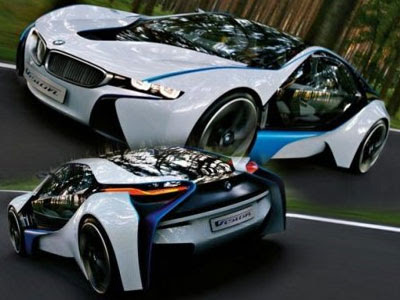
2010 BMW EfficientDynamics Sport Diesel Hybrid Concept Car

2010 BMW EfficientDynamics Sport Diesel Hybrid Concept Car

EfficientDynamics concept
, a world premiere which will be held in September at the Frankfurt Auto Show. Spectacular quadruple-door coupe with the “guillotine” represents the fusion of sportiness and eco-friendliness. Its hybrid power unit consists of a three-cylinder turbo diesel and two electric motors with total capacity 356 hp.
Coupe can move and electric traction, although in this case, the mileage is limited to 50 kilometers. With all three engines accelerate to 100 km / h takes just 4.8 seconds and a top speed of 250 km / h, while fuel consumption does not exceed 3,76 l/100 km.

Saturday, 3 October 2009

The Veyron Bugatti Concept Sport Car by Hartmut Warkuss


Veyron Bugatti Concept Sport Car

The Veyron was designed by Hartmut Warkuss of Volkswagen rather than Giorgetto Giugiaro of ItalDesign who had handled the three prior Bugatti concepts.
Development continued throughout 2001 and the EB 16/4 Veyron was promoted to "advanced concept" status. In late 2001 Bugatti announced that the car, officially called the Bugatti Veyron 16.4 , would go into production in 2003. The car experienced significant problems, however. High-speed stability was difficult, with one prototype destroyed in a crash and another spun out during a press demonstration at the Monterey Historics event in Mazda Raceway at Laguna Seca . Production of the Veyron was delayed indefinitely.
After the release of the car, it has become known that while each Veyron is being sold for £840,000, the production costs of the car are approximately £5 million per vehicle. As Bugatti, and therefore Volkswagen, are making such a huge loss, it has been likened by influential journalist Jeremy Clarkson to Concorde ; both are largely impractical experiments in technology and ground-breaking performance created just to prove that it could be done. A car the like of the Bugatti Veyron may not be seen in production again for some time to come, if at all.
The Veyron features a W16 engine —16 cylinders in 4 banks of 4 cylinders, or the equivalent of two narrow-angle V8 engines mated in a vee configuration. Each cylinder has 4 valves , for a total of 64, but the narrow V8 configuration allows two camshafts to drive two banks of cylinders so only 4 camshafts are needed. The engine is fed by four turbochargers , and it displaces 8.0 L (7,993 cm³/488 in³) with a square 86 by 86 mm bore and stroke.
The Veyron's 16-cylinder engine is based on the innovative "W" design introduced in the 2003 Volkswagen Passat. The Veyron's version features two 90-degree V8s offset by 15 degrees. The offset allows each cylinder to be placed close to its neighbor, which reduces the total size of the massive 8.0-liter engine. A Formula 1?style dry-sump lubrication system keeps the engine moving smoothly. It's easier to spin many small turbochargers than one or two large ones, so Bugatti employs four turbos to reduce boost lag. The strategy works: The engine creates 922 lb.-ft. of torque at only 2,200 rpm.
Putting this power to the ground is a dual-clutch DSG computer-controlled manual transmission with 7 gear ratios via shifter paddles behind the steering wheel. Or it can be driven by full automatic transmission. The Veyron also features full-time all wheel drive , necessary given the output of the engine. It uses special Michelin PAX System run-flat tires, which had to be designed specifically for the Veyron, and which are capable of running at 402 km/h (253 mph).
The car's wheelbase is 2700 mm (106.3 in). Overall length is 4466 mm (175.8 in). It measures 1998 mm (78.7 in) wide and 1206 mm (47.5 in) tall. Curb weight is expected to reach 4300 lb (1950 kg) with a power to weight ratio of 513.3 hp per ton (metric) or 4.36 lb/hp (SAE).The Bugatti Veyron has a total of 10 radiators .

Shelby Twin-Turbo V8 Engine Supercar Ultimate Aero

Shelby Twin-Turbo V8 Engine Supercar Ultimate Aero

Shelby Supercar engine in the base Aero model is same as the previous year, but the Ultimate Aero has a 6.35-litre (387.2 cu in) engine, rated at 1,183 bhp (882 kW) at 6950 rpm and 1,094 lb·ft (1,483 N·m) torque at 6150 rpm, and the supercharger is replaced by a twin turbocharger with cabin adjustable boost pressure. The car is designed to use 91-octane gasoline. The 6-speed transmission is readjusted to increase the theoretical top speed to 273.75 mph (437 km/h) at 7200 rpm, however whether the vehicle is able to reach this speed is highly questionable and has never been tested.
Twin-Turbo V8 Engine with 1183 hp, base price is $654,400. Tested in March 2007 by Guinness world records
Wheels on the base model are sized 18-inch at the front and 19-inch at the rear, while the Ultimate Aero TT has wheels an inch larger at each end.
The 2007 models are heavier, with the base model weighing 2,850 lb (1,290 kg), and Ultimate version 2,750 lb (1,250 kg). Unlike the previous year, base models have a navigation system, 10-speaker audio/CD/DVD system, video/DVD screen, back-up camera, air-conditioning, and trunk space as standard equipment. These come optional on the Ultimate.
The first production 2007 Ultimate Aero TT car was sold on eBay for US $431,100. Later cars are expected to cost US $654,000. Only 24 Ultimate Aero TT's are going to be produced from 2006-2007. The Ultimate Aero TT made its international debut on the International Show Circuit in November 2006, culminating with the world record top-speed competition held in Wolfsburg, Germany in May 2007.

Mustang Saleen S7 Twin Turbo Design Sport Car

Mustang-Saleen-S7-Twin-Turbo-Design-Sport-Car

Saleen knows all about power. As in S281 Mustangs, N2O Focuses and the S7, America’s first (and still the only) mid-engine exotic supercar. When it went on sale in 2002, the S7 was the only street-legal car in the U.S. with more than 500 horsepower and 500 lb-ft of torque. The media and S7 owners have raved about the car since it first smoked the rear tires in anger. And it has been recognized by numerous automotive magazines as the fastest production car in the world. But during the past three years the automobile marketplace has witnessed an explosion of performance with models from manufacturers including Ferrari, Lamborghini, Mercedes-Benz, Porsche and Chevrolet touting power numbers above the once magic 500 level.
Designed by Saleen engineers, the S7's engine and drivetrain incorporate the latest in modern racing technology. The new all-aluminum V8 engine casting was engineered and tooled by Saleen to displace seven liters. Redline is 6500 rpm. Space age materials and engineering are used throughout, including stainless steel valves, titanium retainers, beryllium exhaust valve seats, an aluminum throttle body, Saleen designed aluminum CNC-machined cylinder heads and stainless steel exhaust system. An exclusive Saleen-designed Front Engine Accessory Drive (FEAD) system results in an extremely compact engine, allowing for better packaging and overall weight distribution. The V8 incorporates a unique Saleen-designed side-mounted water pump, a belt-driven camshaft drive and a Saleen-engineered dry sump oil delivery system. The engine's mid-chassis placement optimizes weight distribution and center of gravity, making room for an unusually tall engine that allows for a very efficient induction system. Air enters a roof intake, passes through a 90-mm mass air meter and feeds into a carbon fiber plenum. From the plenum the air is routed to the twin ball bearing turbos, is pressurized to 5.5 psi max and then passes through an oval-bore throttle body into an aluminum intake manifold with eight individual runners.

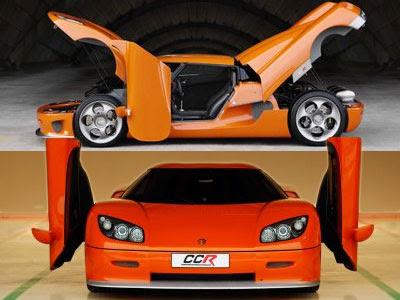
Koenigsegg CCR Design Sport Car Concept

Koenigsegg CCR Design Sport Car Concept

Koenigsegg's design seeks to give an interpretation of strength and flowing motion. The body of a Koenigsegg is formed for one ultimate purpose; speed. Its beauty is the beauty of speed itself. The surfaces are shaped to perfectly aerodynamic, an appearance that does not deceive. All aspects of this machine serve its one fundamental objective. Both the body and chassis of a Koenigsegg are made of extremely lightweight carbon fibre composite, reinforced with Kevlar and aluminium honeycomb. Its race-bred suspension system brings the driver in control of all movement, even under the toughest racing conditions.
The car was styled by Christian von Koenigsegg himself but its shape is largely dictated by aerodynamics. It is not as striking as Pagani or Enzo. At some angles it even looks bulky, like a big whale. But the whale delivers a sense of power that you can't find in its rivals either. Because of the targeted top speed, the body is designed to be so smooth that it has a very low drag coefficient of 0.30. This is much lower than Enzo (0.36), SLR (0.37) and Carrera GT (0.39). Unsurprisingly, the downside is a rather low downforce, just 50kg at the front and 70kg at the back. For comparison, an Enzo generates 775kg while Pagani achieves 500kg.
The chassis is constructed like other supercars. Central to it is a carbon-fiber tub (Koenigsegg called it "semi-monocoque") attached with steel subframe up front and aluminum subframe at the rear for mounting engine, gearbox and suspensions. Chassis rigidity is 28,100Nm per degree despite of the targa roof. The whole bodyshell is also carbon-fiber. Koenigsegg claims a dry weight of 1175kg, which translates to 1275kg when fluid and fuel are loaded, i.e., what we usually refer to "kerb weight". In other words, CC8S is about as light as Pagani and Saleen S7, while being around 100 kilograms lighter than Enzo and Carrera GT.