Saturday, 1 May 2010

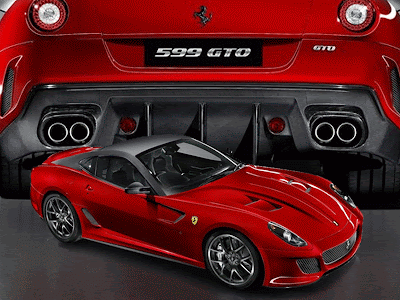
2011 Ferrari 599 GTO Sports Car Concept

The Ferrari 599 GTO is, in fact, the company's fastest ever road car. It is an exclusive limited edition special which, in true Ferrari tradition, is a completely new concept, albeit inspired by a production car. In fact the Ferrari 599 GTO is based on the 599XX, the advanced experimental track car, and can be considered almost a road-going version. The Ferrari 599 GTO is reserved for just 599 clients who seek the maximum expression of high-performance driving. The Ferrari 599 GTO benefits directly from the technological transfer from racing and set a record lap time at Fiorano in 1'24".
2011 Ferrari 599 GTO
The Fiorano lap time provides just one indication of the potential of this car. Just as significant are the technical specifications - 670 hp in a 1495kg car represents a weight-to-power ratio of just 2.23 kg/hp, and ensures a 0-100 km/h acceleration time of just 3.35" as well as a top speed of over 335 km/h.
As is Ferrari's policy, every new Ferrari features new solutions for a road car. Thus the Ferrari 599 GTO is equipped with the latest, second-generation carbon-ceramic brakes which are lighter and offer better performance, new aerodynamic innovations, such as the wheel doughnuts which increase aerodynamic efficiency as well as improve brake cooling, and the Super sport tyres developed by Michelin include a wider front tyre for greater roadholding. The driver-car interface is also new with the adoption of the Virtual Race Engineer (VRE) which provides the driver with instantaneous information on performance.
The GTO (Gran Turismo Omologata) moniker instantly calls to mind two Ferraris that have entered the collective imagination as symbols of performance. After the 1962 250 GTO, which swept the boards in GT racing categories in the 1960s and is now a highly prized collector's car, came the iconic 1984 GTO, which basically invented the entire modern supercar genre.
The web special includes photos, videos and interviews on the new car, while an exclusive preview for a small number of Ferrari clients will be held on April 14th at the Military Academy in Modena. The public debut of the Ferrari 599 GTO will instead be at the Beijing International Motor Show at the end of April.
The Ferrari 599 GTO's engine is directly derived from the 599XX unit implementing, however, the necessary modifications for road-going homologation. It thus complies with Euro 5 and LEV 2 standards. The 5999 cc 65-degree V12 engine punches out 670 CV at 8250 rpm with maximum torque of 620 Nm at 6500 rpm and there is a smooth, constant rush of power all the way to the redline with no loss of flexibility even at medium and low revs. This result was obtained by working on the fluid-dynamics and components to reduce internal friction and by adopting, amongst other things, the 599XX's redesigned crankshaft. The car also has a racing-type intake system with a new manifold with diffuser-type intake geometry and short inlet tracts designed to improve power delivery at high revs and reduce losses. To maximise volumetric efficiency per cylinder, a connection between the two plenums at the front compensates for variations in the volume. This is how the engineers managed to achieve maximum performance at high engine speeds. The engine sound inside the car is carefully controlled to balance the intake sound with the exhaust, which features a 599XX-derived 6-into-1 manifold.
The Ferrari 599 GTO inherits much of the development work - using the same principles as employed in F1 - that went into making the 599XX such an extreme performance car. Reducing weight was a vital objective and the result was the widespread use of composites and components manufactured with technologies more akin to racing specifications. The areas involved include the bodywork and greenhouse (with thinner gauge aluminium and thinner glass), the brakes, transmission and exhaust system. The result is a dry weight of 1495 kg and a weight-to-power ratio of just 2.23 kg/hp, a very significant figure that underlines the GTO's performance potential.
The Ferrari 599 GTO's aerodynamics have benefited significantly from Ferrari engineers' experience in F1 and with the 599XX which allowed downforce to be greatly increased without impacting on drag. Thanks to solutions transferred from the track car to the road-going version, the GTO generates downforce of 144 kg at 200 km/h. The entire car was honed, including the front, the sides, the flat underbody and cooling flows. In the latter instance, the GTO can count on improved ducting to the brake discs and pads, and the adoption of wheel doughnuts - a disc positioned outside the brake disc that ensure that hot air exiting the wheelarch stays as close to the body of the car as possible to reduce drag.
The new CCM2 braking system is lighter and even more consistent in high performance situations. Its consistent coefficient of attrition meant that the ABS could be calibrated to a particularly high performance level, further reducing lap times, thanks to improved deceleration and shorter stopping distances. In fact, the Ferrari 599 GTO boasts an excellent 100 to 0 km/h braking distance of just 32.5 metres. As well as their role in improving aerodynamics, the Formula 1-derived wheel doughnuts also improve braking efficiency by optimising brake cooling.
The car-driver interface was designed to maximise car and driver performance with a layout of the main commands that ensures absolute efficiency and minimum distraction. The Racing manettino also puts the emphasis firmly on sporty, track-specific driving settings by offering the driver full choice with regard to the electronic control parameters. The ICE position on the Ferrari 599 GTB Fiorano has been replaced by CT-Off (traction control off). The GTO is also fitted with bespoke, longer carbon-fibre F1 paddles for easier use in high-speed driving. In addition the GTO also features the Virtual Race Engineer, a system that monitors the status of the car and gives the driver immediate visibility of vehicle performance.

2010 Sportec SP580 Porsche 997 Turbo Facelift - Porsche Sports Car

The new Sportec 997 Turbo SP580 tuning kit is now available for the Porsche 997. Engineers from Sportec have boosted power from 500 PS (368 kW / 493 hp) to 580 PS (572 hp / 427 kW). If those numbers sound familiar, it is because the Swiss tuning firm developed a package that provided the same horsepower on the last SP580. However, the torque rating is reduced on this model, but is the same as the standard Porsche 997 turbo facelift.
Sportec SP580 Porsche 997 Turbo Facelift
Now, the new model sprints to 100 km/h in just 3.2 seconds, and to 200 km/h in 10.3 seconds. Top speed on the car is 323 km/h. The sprint times are faster than the old SP580, but the previous model topped out at 338 km/h (210 mph).
New forged 20-inch wheels have been developed for the car.  However, the aero kit with front spoiler, big rear wing, and side skirts seems to be carried over from the pre-facelift kit.
With the new SP580 Sportec is once more prowling in the stomping ground of the super sports car. True to the sporty understatement Sportec the Porsche 997 turbo is a real leopard in wolf's clothing - this is ensured by the full 580 PS and powerful 650 Nm torque that can be had at just 1.950-5.000 revs.
Thus equipped the Sportec SP580 achieves the standard spring from 0 to 100 km/h in only 3.2 seconds. The occupants of the SP580 are catapulted from 0 to 200 km/h in a breathtaking 10.3 seconds. Only at 323 km/h does the revolution limiter put an end to this flush of speed.
Externally only the powerful Sportec Mono7 forged 20 inch wheels and the completely new aerodynamic package that holds true to the Sportec Motto "more substance, less style", suggest that beholder isn't looking at a mass production vehicle from Zuffenhausen. An aerodynamically optimised front spoiler, discrete side skirts along with a larger tail plane - as an option also to be had in carbon - both technically and optically complete the SP580. And if that wasn't enough the exterior mirrors and the air intakes can be had in matt carbon.
The aluminium pedals and foot supports as well as the bucket seats are all further signs of its sportiness. And for those who like it a little sportier there is a lowering set that brings the chassis around 20 millimetres nearer to the tarmac. For use on the race track Sportec offers a special PASM compatible super sports suspension that can be individually adjusted to suit every purpose and all race track conditions.

2010 Ariel Atom 500 V8 - Ariel Sports Cars

Ariel announce the latest version of the Atom - the Ariel Atom 500, powered by a small V8 engine. With over 500bhp in a 500kilo package the Atom 500 will boast one of the highest power to weight ratios ever for a production car, ever. At over 1000bhp per tonne the Atom 500 will be the ultimate statement in performance and is destined to be made in a limited edition.
Ariel Atom 500 V8
The V8 powered Atom is the first of some exciting developments from Ariel due to be released though 2008 and builds on the growing reputation that the company has for putting the passion back into driving and producing sports cars that are fun to drive as well as fast both on and off the track.
The Ariel Atom 500 V8 project first began back in 2007 as a special model created in conjunction with RS Developments. The car features the same RS (Russell Savory) designed supercharged, 2.4 litre V8 engine connected to a 6 speed sequential Sadev gearbox driving the rear wheels. The gearbox has power-on shift capability, paddle gearchange with manual override as well as launch and traction control.
The Ariel Atom 500 V8 is identifiable from the standard Atom by the twin rear intakes for intercoolers and unique anodized gold color scheme for the chassis and wheels and carbon fibre panels and carbon fibre aerofoils. Other features include chromemoly aerofoil wishbones, multi-function steering wheel, Alcon 4 piston caliper brakes and lightweight Dymag magnesium wheels.
Said Simon Saunders, Director of Ariel, 'This is an interesting project for us and an experimental departure from what we normally produce. For a few customers the Atom 500 will be the ultimate expression of lightweight performance and represents the outer limits of what is achievable in a road registered car. 
We also use this sort of project to explore the possibilities of how we can improve our standard cars. The Honda engined production cars already combine all the elements that we want in an Atom and by pushing the envelope to these sorts of extremes we can further improve the breed'.
Prices have not yet been released, but the first customer’s Ariel Atom 500 V8 will be built in spring. Ariel Director Simon Saunders said: ‘The Atom 500 will be the ultimate expression of lightweight performance and represents the outer limits of what is achievable in a road registered car.’
With the standard Atom 300 already achieving sub 3 second times to 60mph and sub 7 second times to 100mph, the 500 will take this one stage further with record breaking production car possibilities.

2010 AF-10 Arash Sports Car

Arash Motor Company was born out of a passion for cars, the allure of beauty and the thrill of driving the seemingly end less acceleration of a thoroughbred engine. The engine, or better still, the soul of the AF10 is designed to withstand the punishment of motor racing and we’re sure it will excite even the most accomplished of drivers.
2010 AF-10 Arash
The superlative handling of a chassis designed by leaders in their field combined with extraordinarily forceful braking performance will make you question whether the tyres will still be intact when you climb out. The AF10 seduces and excites on every level with it’s distinctive silhouette and exceptional performance.
Design of the Arash AF10 began in 2005 with styling sketches and renderings. Gradually the design evolved into computer models and aerodynamic CFD mesh models. Finally the finished car was revealed in October 2008.
Powering the Arash AF10 is a GM sourced, mid-mounted, 7.0 litre, V8 which produces 550 bhp @ 6,000 rpm. This is connected to a Grazianno 6-speed manual transmission driving the rear wheels. This drivetrain allows the AF10 to reach 60 mph in 3.4 seconds, and go on to a 204 mph top speed.
The Arash AF10 features a full carbon and steel frame chassis with steel front and rear crash structures and cradles. Covering the chassis is an all carbon fiber body with honeycomb and nomex sandwiches to achieve weight reductions and add rigidity.
The aerodynamic body of the Arash AF10 includes unusual features like the radical front wing which is separated from the main body, and prominent air intake side pods. These features have been influences by Le Mans and F1 race cars, however they also perform specific functions for the overall performance of the car. Split radiators have been used at the front and Oil radiators are positioned in the side pods.
The modular carbon chassis of the Arash AF10 is super light and super strong. This structure is made up of 13 parts assembled into a jig and bonded at temperature.
An estimated 25 Arash AF10 cars will be manufactured per year with a small number being delivered to the US market.
About Arash Cars:
Arash Cars was established in March 2006 and has been working on the AF10 ever since. The styling drawings were made in March 2005 by Arash Farboud Designs and have since been converted into computer models and aerodynamic cfd mesh models.
The company is located in Sawston on the outskirts of Cambridge. Most testing will be conducted at Millbrooke proving grounds 20 miles away from the company. The facility in Sawston Cambridge is equipped with a styling studio, painting booth, carbon lamination room, parts despatch area, carbon curing autoclave oven and polished epoxy floored car assembly stations. A board room and administration offices are also located at the site.
Arash Cars have designed a traditionally shaped badge with an eagle emblem. The background colour is solid black and the foreground eagle is in gold. The 'Arash' emblem is in flame orange.

Monday, 26 April 2010

2010 Naomi for Haiti Lotus Evora Sports Cars

In response to the horrific natural disaster that has crippled the nation of Haiti, Naomi Campbell together with Lotus Cars will be auctioning eight special edition "Naomi for Haiti" Lotus Evora sports cars, with the proceeds from the auction going to help the relief effort in Haiti on 12th of January 2010.
2010 Naomi for Haiti Lotus Evora Sports Cars
The Lotus Evora Naomi for Haiti has to be one of the most expensive special edition ever to come out of the company's plant. The firs two Lotus Evora Naomi for Haiti units have been auctioned for more than 300,000 GBP each at The Fashion For Relief Event. The first Lotus Evora Naomi for Haiti was bought by Naomi Campbell’s boyfriend, Vladimir Doronin for no less than 320,000 GBP.
The remaining five Lotus Evora Naomi for Haiti will be auctioned starting from today on the supermodel's website at www.naomiforhaiti.com. The highest bidders and the new owners of the remaining five Lotus Evora Naomi for Haiti cars will be announced at the Lotus press conference on the 2nd of March at the Geneva Motorshow.
The Lotus Evora is a very desirable, multi-award winning, high performance, mid-engined sports car that presents a fantastic piece of design to bid on. The “Naomi for Haiti” Evora sports car has been specially designed by Lotus Design Director Donato Coco and reflects Naomi’s design direction. The bespoke styling combines the flag of Haiti with a dramatic colour scheme and the cars include a full range of options, meaning these cars will all become desirable collectors items.
The “Naomi for Haiti” Evoras will be auctioned at Naomi Campbell's Fashion for Relief TM charity fashion show on the 18th of February at the London Fashion Week venue at Somerset House. The remaining “Naomi for Haiti” Evoras will be entered into an auction run on the “Naomi for Haiti” website Charity Auction - Naomi For Haiti and bidding will commence at 0800 GMT on the 19th of February and will end at 1200 noon GMT on 28th of February 2010.
According to Naomi, Lotus Cars has been Fashion for Relief’s biggest supporter and has been instrumental in helping us to raise crucial funds for The White Ribbon Alliance and its partners in Haiti. Still according to her, to have Lotus on board supporting Fashion for Relief is very important to Sarah Brown, myself and everyone at The White Ribbon Alliance and we are truly very grateful.
Naomi Campbell says, "I am deeply saddened by the recent tragedy in Haiti. So many have been killed and severely affected by the earthquake - women and children in particular are most vulnerable in disasters. Fashion is universal, personal and touches everyone. I am delighted that Lotus Cars is supporting my Fashion for Relief TM charity and I am sure with such generous help we will raise crucial funds to help save the lives of women and children."
Lotus CEO, Dany Bahar said “It was a great pleasure for Lotus to work with Naomi and the White Ribbon Alliance for this excellent cause and we are delighted that by working with Naomi, our suppliers and the generosity of the bidders, we have been able to raise such a significant sum of money to help those in need during this difficult time.”
It was announced on March 11, 2010 at the 80th Geneva Motor Show that the eight special editions of the Lotus Evora Naomi for Haiti have achieved in excess of €1.4m at auction.

2009 Audi Sports Car roadster/coupe TT-RS

Although the 2009 Audi TT has improved greatly on previous models in terms of general fun-factory and handling, enthusiasts still don't place it in the same league as the M Coupes, Boxter/Caymans and S2000s of the world. The S line model, which debuted in 2008, served up a big helping of improvements, but Audi fans still wanted more.
2009 Audi TT-RS
Audi is once again producing a five-cylinder engine – and a very special one at that. Arriving at dealerships this summer, the TT RS has a turbocharged 2.5-liter engine with direct gasoline injection; it produces 250 kW (340 bhp) and 450 Nm (331.90 lb.-ft.) of torque. The blazing five-cylinder engine enables the TT RS to perform extraordinary feats. In conjunction with quattro permanent all-wheel drive and a high-performance chassis, the engine makes the compact Audi TT RS a top-notch sports car – available as a coupé or roadster.
Sporty five-cylinder gasoline engines have a long legacy at Audi. The most famous is arguably the turbocharged 2.1-liter engine in the Audi quattro. The first version, which was launched in 1980, offered an impressive 147 kW (200 bhp). And the Sport quattro from 1984, directly inspired by motorsport, delivered a whopping 225 kW (306 bhp). For 25 years, turbochargers and quattro have been a dynamic formula for success.
Audi has resumed using this recipe. Designed from scratch, the five-cylinder engine combines a turbocharger with FSI direct gasoline injection to elevate the TT RS to a high-performance sports car. The TFSI delivers 250 kW (340 bhp) from a displacement of 2,480 cc (151.34 cu in): a specific output of 100.8 kW (137.1 bhp) per liter.
The power-to-weight ratio is also outstanding. In the case of the Coupé, which weighs in at a mere 1,450 kilograms (3,196.70 pounds), the power-to-weight ratio is just 4.3 kilograms per bhp.
The TT RS Coupé rockets from 0 to 100 km/h (0 to 62.14 mph) in 4.6 seconds; the Roadster needs just a tenth of a second longer. The limited top speed of 250 km/h (155.34 mph) is merely the official figure for both versions; as an option, Audi can increase it to 280 km/h (173.98 mph).
Almost even more impressive is the aggressive pulling power. The maximum torque of 450 Nm (331.90 lb.-ft.) is always available between 1,600 and 5,300 rpm. In addition, the TT RS overtakes without the slightest effort. Last but not least, its engine makes passengers’ skin tingle time and again thanks to its speedy and powerful response, its inspiring free-revving character, and its unmistakably guttural tailpipes: five-cylinder classical music by Audi!
As an uncompromising sports-car engine, the 2.5-liter TFSI is ultra-compact. Just 49 centimeters (19.29 inches) in length, it is ideally suited for transverse installation in the TT RS. And its weight of just 183 kilograms (403.45 pounds) also sets a record. The crankcase is made of vermicular-graphite cast iron. This high-tech material unites the utmost in strength with low weight; it has otherwise only been used for the large TDI engines from Audi. Perfectly placed reinforcements enhance the block’s loadability. The lightweight cylinder head, the pistons, and the connecting rod are lightweight as well as high-strength.
The ultra-powerful five-cylinder engine is extremely fuel-efficient, requiring an average of just 9.2 liters/100 km [25.57 mpg] as regards the Coupé (Roadster: 9.5 l/100 km [24.76 mpg]). Switchable flaps in the intake manifold mix the incoming air in a calculated configuration. Injected at a pressure as high as 120 bar by the common-rail system, the gasoline swirls intensely in the combustion chamber – which in turn cools the walls. This subsequently facilitates a compression ratio of 10.0:1, which is very high for a turbocharged engine. Both of the adjustable camshafts, controlled via chains, also enhance charging efficiency with respect to the air-fuel mixture.